

Electrolyzer as a Service Market Forecast 2026–2036: Market to Reach USD 12.3 Billion by 2036 at 24.1% CAGR
Service-led hydrogen procurement accelerates adoption as output-based contracting reshapes electrolyzer deployment models
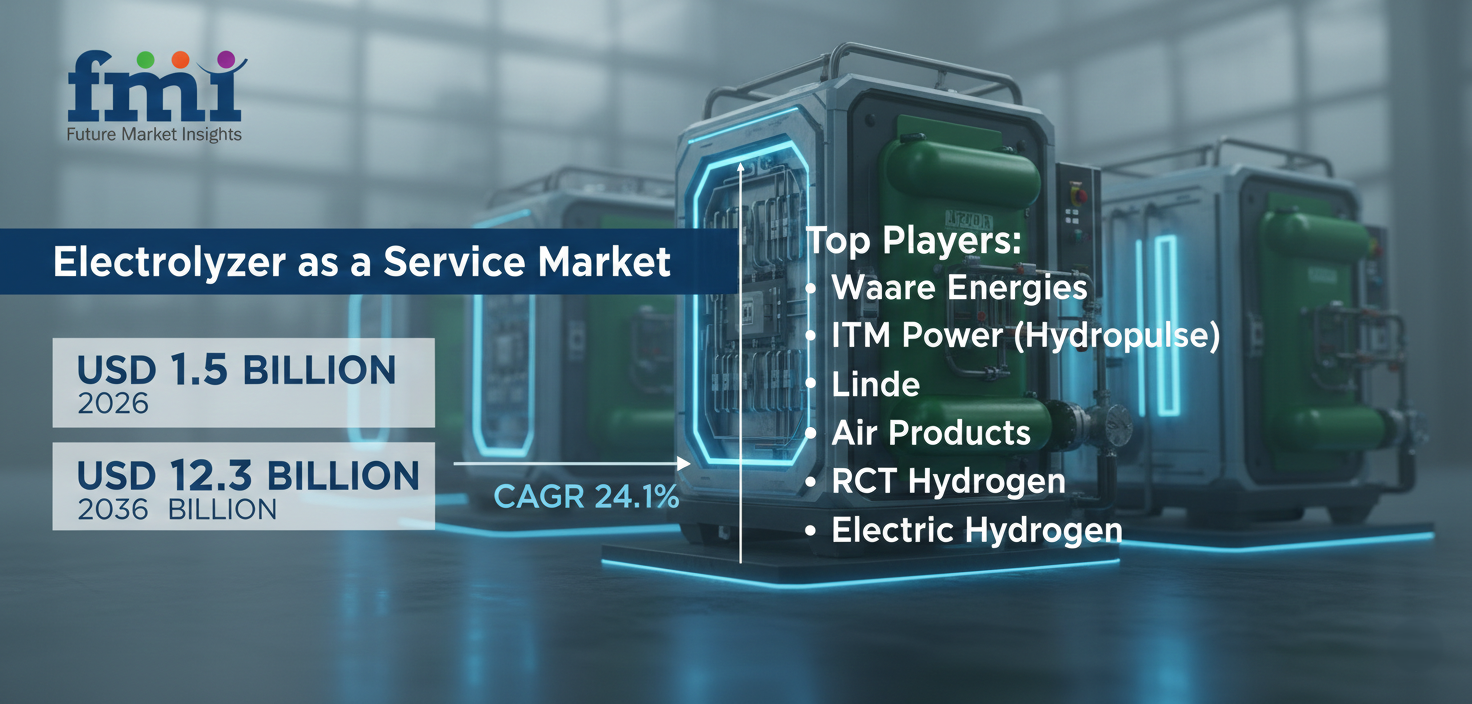
NEWARK, DE, UNITED STATES, February 27, 2026 /EINPresswire.com/ -- The global Electrolyzer as a Service market was valued at USD 1.2 billion in 2025. FMI estimates the market will reach USD 1.5 billion in 2026 and surge to USD 12.3 billion by 2036, expanding at a CAGR of 24.1% during the forecast period. An absolute dollar opportunity of USD 11.1 billion is projected between 2026 and 2036, with the market expanding nearly 8.4 times from its 2026 base.
Growth is being fueled by service-led procurement structures that reduce upfront capital expenditure, shift performance and uptime risk to specialized providers, and bundle engineering, operations, and maintenance into a single contractual framework. Output assurance, availability guarantees, and faster commissioning cycles are becoming central to early adoption across industrial and mobility-linked hydrogen demand centers.
Electrolyzer as a Service Market Snapshot (2026–2036)
• Market size in 2026: USD 1.5 billion
• Market size in 2036: USD 12.3 billion
• CAGR (2026–2036): 24.1%
• Leading technology: PEM electrolyzers (46% share)
• Top contract model: Pay-per-kg H₂ / Output-based (39%)
• Dominant deployment model: Onsite (Behind-the-meter) – 61%
• Fastest-growing country: India (24.6% CAGR)
• Key players: Waaree Energies, ITM Power (Hydropulse), Linde, Air Liquide, Air Products, RCT Hydrogen, Electric Hydrogen
Market Momentum
The market begins 2026 at USD 1.5 billion, supported by early industrial deployments where hydrogen buyers prefer contracted supply over asset ownership. Between 2027 and 2030, adoption accelerates as hydrogen hubs, industrial clusters, and mobility corridors formalize output-linked procurement structures.
From 2031 onward, scale is reinforced by standardized plant configurations, improved remote monitoring capabilities, and long-term offtake agreements that enhance bankability. By 2036, service-based electrolysis becomes a mainstream commercial pathway for hydrogen production, particularly where utilization certainty and operational accountability are prioritized.
Request For Sample Report | Customize Report |purchase Full Report - https://www.futuremarketinsights.com/reports/sample/rep-gb-32109
Why the Market is Growing
The Electrolyzer as a Service model is expanding as buyers seek to avoid high upfront electrolyzer capex and internal operational complexity. Service contracts transfer uptime responsibility, maintenance obligations, and efficiency risk to providers under defined service-level terms.
Hydrogen output pricing structures—particularly pay-per-kilogram models—are aligning payments with delivered hydrogen volumes. This reduces utilization risk for adopters facing demand uncertainty. Additionally, bundled delivery models combine system installation, balance-of-plant integration, performance monitoring, and maintenance under one agreement, streamlining project execution.
Rather than focusing solely on equipment procurement, customers are increasingly prioritizing continuity of supply, performance accountability, and predictable operating expenditure.
Segment Spotlight
1. Technology: PEM Leads Commercial Adoption
PEM electrolyzers account for 46% of demand in 2026, favored for operational flexibility under variable renewable power input and their suitability for output-based contracting structures. Alkaline electrolyzers follow at 42%, particularly in stable utilization environments where standardized maintenance cycles support service economics.
2. Contract Model: Output-Based Structures Dominate
Pay-per-kg H₂ or output-based contracts hold 39% market share, reflecting preference for outcome-linked payment mechanisms. Lease or subscription models account for 33%, appealing to customers seeking recurring fee structures without asset ownership. BOOT arrangements are gaining relevance in large integrated projects where transfer terms are predefined.
3. Deployment: Onsite Installations Lead
Onsite (behind-the-meter) deployments represent 61% of installations, driven by industrial users requiring hydrogen at the point of consumption. This model reduces logistics complexity while enabling providers to maintain operational control.
Drivers, Opportunities, Trends, Challenges
Drivers
• Capital expenditure reduction through service contracts
• Transfer of performance and uptime risk to providers
• Growth of hydrogen hubs and cluster-based deployment
Opportunities
• Multi-site fleet standardization
• Lifecycle service add-ons and spares pooling
• Bankable long-term offtake-backed contracts
Trends
• Performance-linked pricing structures
• Standardized modular plant design
• Remote diagnostics and centralized O&M coverage
Challenges
• Grid interconnection delays and permitting timelines
• Balance-of-plant complexity in industrial integration
• Contractual risk allocation and liability structuring
Country Growth Outlook (2026–2036)
India leads global growth at 24.6% CAGR, supported by early service-led deployments that reduce capital barriers. The United States follows at 22.0% CAGR, driven by hub-based aggregation and output-linked procurement structures. Saudi Arabia expands at 21.2% CAGR, supported by integrated giga-project frameworks.
Germany grows at 20.3%, reflecting compliance-driven contracting and industrial corridor deployment. France registers 19.4% CAGR, while the UK expands at 18.7% amid cluster-led decarbonization initiatives. Japan progresses at 17.9%, paced by structured qualification and procurement cycles.
Competitive Landscape
The market is emerging as a contract-led competitive environment where differentiation depends less on stack branding and more on financing capability, execution strength, and operational reliability.
Companies such as Waaree Energies, ITM Power, Linde, Air Liquide, and Air Products are focusing on project origination, renewable power access, standardized balance-of-plant integration, and multi-year operations capability.
Competitive advantage increasingly hinges on:
• Bankable contracting frameworks
• Modular plant replication across sites
• Strong EPC and commissioning capabilities
• Remote monitoring and uptime optimization
Frequently Asked Questions (FAQ)
What is the Electrolyzer as a Service market size?
The market is estimated at USD 1.5 billion in 2026 and projected to reach USD 12.3 billion by 2036.
What is the expected growth rate?
The market is forecast to expand at a CAGR of 24.1% between 2026 and 2036.
What defines Electrolyzer as a Service?
It is a commercial model where a provider finances, installs, owns, and operates electrolyzer systems and supplies hydrogen under a contracted structure such as pay-per-kg, subscription, or BOOT.
Why is service-led electrolysis gaining traction?
It reduces capital intensity, transfers performance risk, aligns payments to delivered hydrogen output, and accelerates project deployment in industrial and mobility applications.
Explore More Related Studies Published by FMI Research:
Expandable Microspheres Market https://www.futuremarketinsights.com/reports/expandable-microspheres-market
Polyvinyl Butyral PVB Market https://www.futuremarketinsights.com/reports/polyvinyl-butyral-pvb-market
Potassium Tetrafluoroborate Market https://www.futuremarketinsights.com/reports/potassium-tetrafluoroborate-market
About Future Market Insights (FMI)
Future Market Insights, Inc. (FMI) is an ESOMAR-certified, ISO 9001:2015 market research and consulting organization, trusted by Fortune 500 clients and global enterprises. With operations in the U.S., UK, India, and Dubai, FMI provides data-backed insights and strategic intelligence across 30+ industries and 1200 markets worldwide.
Why FMI: https://www.futuremarketinsights.com/why-fmi
Sudip Saha
Future Market Insights Inc.
+1 347-918-3531
rahul.singh@futuremarketinsights.com
Legal Disclaimer:
EIN Presswire provides this news content "as is" without warranty of any kind. We do not accept any responsibility or liability for the accuracy, content, images, videos, licenses, completeness, legality, or reliability of the information contained in this article. If you have any complaints or copyright issues related to this article, kindly contact the author above.
