

Polyolefin Pipe Market: A USD 44.4 Billion Infrastructure Pillar by 2036
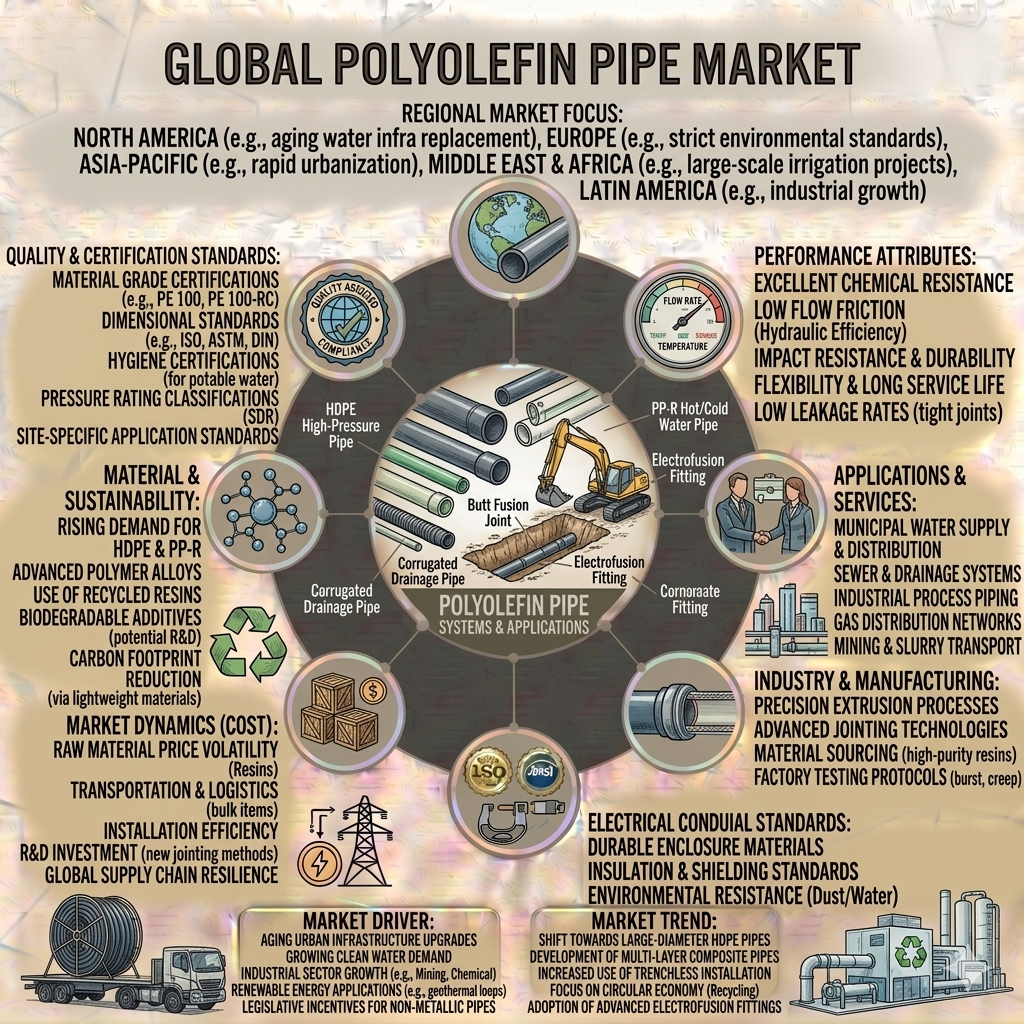
Polyolefin Pipe Market
The polyolefin pipe market is valued at USD 25.0 billion in 2026 and projected to reach USD 44.4 billion by 2036 at a CAGR of 5.9%.
NEWARK, DE, UNITED STATES, April 2, 2026 /EINPresswire.com/ -- The global transition toward resilient, low-maintenance utility networks is accelerating a massive shift in the industrial piping landscape. New market intelligence reveals that the Global Polyolefin Pipe Market is valued at USD 25.0 billion in 2026 and is projected to reach USD 44.4 billion by 2036, growing at a CAGR of 5.9%.
This steady climb is driven by a move away from legacy metal and concrete assets in favor of high-performance polymers. As cities prioritize leak reduction and long-term network reliability, polyolefin pipes—specifically Polypropylene (PP) and Polyethylene (PE)—have emerged as the mechanical necessity for modern water, gas, and energy infrastructure.
Get Access of Report Sample:
https://www.futuremarketinsights.com/reports/sample/rep-gb-19128
Material Dominance: The Strength of Polypropylene
The market is currently led by Polypropylene (PP) pipes, which command a 52.0% share of global demand. Engineers increasingly specify PP for its unique balance of mechanical rigidity and thermal stability.
• High-Temperature Resilience: Unlike standard plastics, PP maintains its dimensional integrity under significant temperature variations, making it the preferred choice for industrial fluid transport and district heating.
• Chemical & Stress Resistance: Its inert nature allows it to withstand aggressive soil conditions and chemical exposure without the corrosion risks associated with steel or iron.
• Installation Efficiency: The lightweight structure of polyolefin pipes reduces transportation costs and enables faster deployment, which is critical for minimizing public disruption during urban utility upgrades.
Sector Spotlight: Power, Communication, and Water
While fluid conveyance remains a core application, the Power and Communication sector has emerged as the largest demand driver, accounting for 40.0% of the market.
Polyolefin pipes serve as the primary protective conduit for the world's expanding underground cable networks. These pipes provide essential insulation and mechanical protection against moisture and soil movement, ensuring the integrity of high-voltage power lines and fiber-optic communication links. Additionally, the shift toward trenchless installation methods—which allow pipes to be pulled through the ground with minimal excavation—is favoring the flexibility of polyethylene systems in dense urban environments.
Regional Growth Leaders: Asia-Pacific and the UK
The global polyolefin pipe market is experiencing robust regional expansion, led by South Korea with a projected 7.9% CAGR through 2035, fueled by the massive replacement of aging municipal water and sewage networks alongside significant gas modernization efforts. Japan follows with a 7.1% CAGR, where market demand is anchored in a strategic focus on seismic resilience and maintaining high-purity water quality standards for its aging infrastructure. In the United Kingdom, a 7.0% CAGR is driven by utility-led leakage control programs and the rise of modular urban redevelopment projects. China is expected to grow at a 6.5% CAGR, supported by the expansion of industrial utility piping and national initiatives aimed at reducing water loss. Finally, India maintains a steady 6.4% CAGR, with growth primarily attributed to large-scale urban sanitation projects and the continued expansion of agricultural irrigation networks.
Competitive Landscape: The Global Tier-1 Players
The polyolefin pipe market is defined by a group of specialized manufacturers providing integrated, end-to-end piping solutions.
• Uponor & Georg Fischer: These European giants lead in engineered systems for water and gas distribution, focusing on advanced jointing technologies that ensure leak-proof performance for 50+ years.
• WL Plastics & JM Eagle: Major players in the North American market, specializing in high-density polyethylene (HDPE) for large-scale energy, mining, and municipal projects.
• Borealis: A critical link in the supply chain, providing the high-grade polyolefin resins that enable the extreme pressure ratings required for modern utility standards.
Frequently Asked Questions (FAQ)
1. Why are polyolefin pipes replacing traditional metal pipes?
The primary reason is corrosion. Metal pipes eventually rust or scale, leading to leaks and reduced water quality. Polyolefin pipes are chemically inert, meaning they do not rust, rot, or corrode, which significantly extends the life of underground assets.
2. What is "Fusion Welding" and why is it important?
Unlike traditional pipes that use mechanical joints or gaskets (which can be points of failure), polyolefin pipes are often joined using heat fusion. This creates a single, continuous "monolithic" line where the joint is as strong as the pipe itself, virtually eliminating the risk of leaks.
3. Are these pipes environmentally friendly?
Yes, in several ways. They have a lower carbon footprint during manufacturing and transport compared to heavier materials. Furthermore, because they are highly resistant to leaks, they prevent the massive loss of treated drinking water—a major sustainability concern for modern municipalities.
4. How do these pipes handle earthquakes?
Materials like High-Density Polyethylene (HDPE) are incredibly flexible. During seismic activity, the pipe can bend and shift with the earth rather than snapping, which is why they are heavily favored in regions like Japan and the western United States.
5. Can these pipes be used for high-pressure gas lines?
Absolutely. Specialized polyolefin formulations are certified for high-pressure natural gas distribution. Their ability to resist "Slow Crack Growth" (SCG) makes them one of the safest materials available for underground gas networks.
Browse More Industry Reports :
Polyolefin Odor Removal Additives Market
https://www.futuremarketinsights.com/reports/polyolefin-odor-removal-additives-market
Polyolefin for Medical Devices Market
https://www.futuremarketinsights.com/reports/polyolefin-for-medical-devices-market
Polyolefin in Pharmaceutical Packaging Market
https://www.futuremarketinsights.com/reports/polyolefin-in-pharmaceutical-packaging-market
Sudip Saha
Future Market Insights Inc.
+1 347-918-3531
email us here
Legal Disclaimer:
EIN Presswire provides this news content "as is" without warranty of any kind. We do not accept any responsibility or liability for the accuracy, content, images, videos, licenses, completeness, legality, or reliability of the information contained in this article. If you have any complaints or copyright issues related to this article, kindly contact the author above.
